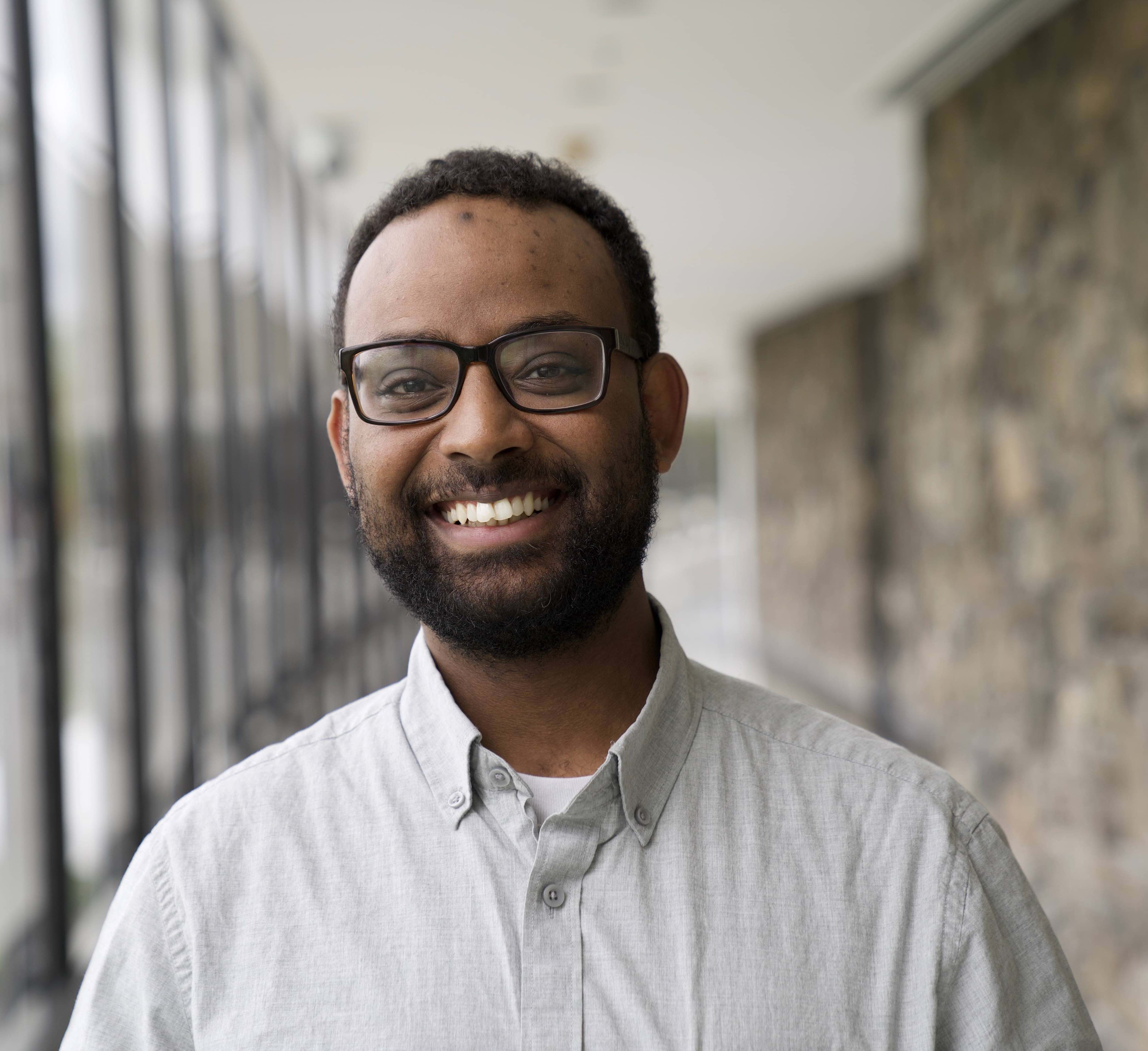
Picture of Abraham Asfaw, Ph.D.

News

  • [September 2025] The Deltakit textbook is out now! It's a practical, hands-on introduction to quantum error correction concepts, with emphasis on building the circuits clearly with all details shown.
  • [August 2025] I spoke at QEC25 at Yale University about the challenges of running real-time QEC experiments and hardware + software tools to make it easier.
See more
  • [April 2025] I joined Riverlane! Excited to work on and learn even more about QEC experiments.
  • [December 2024] The Google Coursera course on quantum error correction is out! Back in 2022 after the first set of QEC experiments, I'd started an internal course for members of the quantum team covering quantum error correction topics with Dave Bacon. This is the updated version of that internal course, taught by Austin Fowler.
  • [August 2024] New QEC results! This time, with distance 7 outperforming the best physical qubit on the device by >2x. Quantum error correction below the surface code threshold is now on the arXiv.
  • [May 2023] We are recruiting new quantum hardware residents! Excited to see what results they achieve.
  • [November 2022] I started a quantum hardware residency program to give access and support to external researchers who want to use Google's quantum devices. Before this, the Google quantum team had paused external usage after a beta test pre-2021. This program restarts the commitment to serve external users.
  • [July 2022] It looks like the era of quantum error correction experiments is here! Suppressing quantum errors by scaling a surface code logical qubit is now on the arXiv with shiny figures explaining the quantum circuits clearly.
  • [April 2022] New Meet a Quantum Mechanic videos out!
  • [September 2021] I joined Google Quantum AI!
  • [December 2020] I defended my dissertation successfully on December 28, 2020! Ph.Done.
  • [December 2020] Our paper describing the thought process behind the Qiskit textbook and some recent usage data is now on the arXiv! [arXiv:2012.09629]
  • [October 2020] Qubit x Qubit, our partnership with The Coding School to teach quantum computing to 5000 high school students (and above) globally over 8 months and 2 semesters, begins! [IBM Research announcement]

    It's the first of its kind, and offers high schoolers the opportunity to take a course on hands-on quantum computing with Qiskit and the IBM Quantum Experience in two semesters, with the potential to earn high school credit.

  • [September 2020] The video lectures and labs from the Qiskit Global Summer School are now live on qiskit.org.
  • [July 2020] Qiskit Global Summer School begins! [IBM Research announcement]

    It's the world's largest quantum computing summer school, with 4000+ learners from 100+ countries.

  • [June 2020] I hosted Real Scientists on Twitter! [Real Scientists announcement]
  • [May 2020] The IBM Quantum Challenge launches! [IBM Research announcement] [IBM Research retrospective] [Exercises]

    The Challenge celebrates 4 years of quantum computers on the cloud, and contains four exercises, starting with quantum gates and going through measurement error mitigation on real quantum systems, as well as quantum key distribution and unitary decomposition into quantum circuits.

  • [January 2020] I am now leading a team at IBM Quantum focused on building a global mission for quantum education & open science. The goal of the team is to make quantum computing education & science open, accessible and inclusive for all.
  • [September 2019] Learn Quantum Computation using Qiskit (the Qiskit Textbook) is live! [IBM Research announcement] [Qiskit Announcement]

    It's the first open-source digital textbook in the field, showing how to program quantum computers and implement quantum algorithms in detail.

  • [August 2019] Coding With Qiskit, a 9-episode video series on YouTube explaining how to program quantum computers, launches.
  • [March 2019] I joined the team at IBM Quantum, based at the T.J. Watson Research Center in Yorktown Heights, NY.

Selected Publications

For an up-to-date list of publications, please visit my Google Scholar page.
  • Cover image of Deltakit Textbook: A Hands-on Introduction to Quantum Error Correction Concepts

    Deltakit Textbook: A hands-on introduction to quantum error correction concepts

    Abraham T. Asfaw, Angela Burton, Earl Campbell, Gemma Church, Ophelia Crawford, Liz Durst, Kallie Ferguson, Tom Hartley, Elisha Matekole, Guen Prawiroatmodjo, Amirreza Safehian, Adrien Suau

    deltakit.github.io/deltakit-textbook (2025).

    QEC is a key ingredient to unlock the full potential of quantum computers. To build large-scale error-corrected quantum computers with hundreds to thousands of logical qubits running millions to billions of operations, we will need the participation of experts across various disciplines, and they will all need to upskill in QEC. Today, QEC talent is rare, and awareness about QEC concepts is the most frequently reported challenge as quantum computing teams begin their journeys toward fault tolerance. This textbook aims to bridge the gap between the understanding of QEC and the practice of QEC. The core principles for the textbook are being hands-on, detailed, interactive and open-source.

  • Screenshot of publication titled Teaching Quantum Computing with an Interactive Textbook

    Teaching Quantum Computing with an Interactive Textbook

    James R. Wootton, Francis Harkins, Nicholas T. Bronn, Almudena Carrera Vazquez, Anna Phan, Abraham T. Asfaw

    IEEE QCE 2021, 385-391 (2021).

    Quantum computing is a technology that promises to offer significant advantages during the coming decades. Though the technology is still in a prototype stage, the last few years have seen many of these prototype devices become accessible to the public. This has been accompanied by the open-source development of the software required to use and test quantum hardware in increasingly sophisticated ways. Such tools provide new education opportunities, not just for quantum computing specifically, but also more broadly for quantum information science and even quantum physics as a whole. In this paper we present a case study of one education resource which aims to take advantage of the opportunities: the open-source online textbook 'Learn Quantum Computation using Qiskit'. An overview of the topics covered is given, as well as an explanation of the approach taken for each.

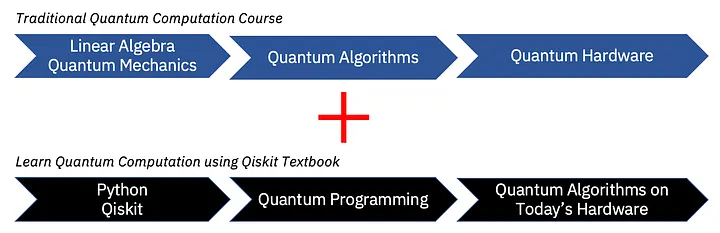
  • Screenshot of Learn Quantum Computation Using Qiskit textbook

    Learn Quantum Computation Using Qiskit

    Abraham T. Asfaw, Luciano Bello, Yael Ben-Haim, Sergey Bravyi, Nicholas Bronn, Lauren Capelluto, Almudena Carrera Vazquez, Jack Ceroni, Richard Chen, Albert Frisch, Jay Gambetta, et al.

    qiskit.org/textbook (2019).

    This is the first digital open-source textbook on quantum computation, demonstrating how to implement quantum algorithms on real quantum computers. The textbook is designed as a supplement to traditional quantum computing textbooks for university courses. It covers the mathematics behind quantum algorithms, details about today's non-fault-tolerant quantum devices, and shows how to write code in Qiskit to implement quantum algorithms on IBM's cloud quantum systems.

  • Figure from Narrow Optical Line Widths in Erbium Implanted in TiO2

    Narrow Optical Line Widths in Erbium Implanted in TiO2

    Christopher M Phenicie, Paul Stevenson, Sacha Welinski, Brendon C Rose, Abraham T Asfaw, Robert J Cava, Stephen A Lyon, Nathalie P De Leon and Jeff D Thompson

    Nano Letters 19, 12, 8928-8933 (2019).

    Atomic and atom-like defects in the solid-state are widely explored for quantum computers, networks and sensors. Rare earth ions are an attractive class of atomic defects that feature narrow spin and optical transitions that are isolated from the host crystal, allowing incorporation into a wide range of materials. However, the realization of long electronic spin coherence times is hampered by magnetic noise from abundant nuclear spins in the most widely studied host crystals. Here, we demonstrate that Er\(^{3+}\) ions can be introduced via ion implantation into TiO\(_2\), a host crystal that has not been studied extensively for rare earth ions and has a low natural abundance of nuclear spins. We observe efficient incorporation of the implanted Er\(^{3+}\) into the Ti\(^{4+}\) site (40% yield), and measure narrow inhomogeneous spin and optical linewidths (20 and 460 MHz, respectively) that are comparable to bulk-doped crystalline hosts for Er\(^{3+}\). This work demonstrates that ion implantation is a viable path to studying rare earth ions in new hosts, and is a significant step towards realizing individually addressed rare earth ions with long spin coherence times for quantum technologies.

  • Figure from Nanowire Superinductance Fluxonium Qubit

    Nanowire Superinductance Fluxonium Qubit

    T. M. Hazard, A. Gyenis, A. Di Paolo, A. T. Asfaw, S. A. Lyon, A. Blais and A. A. Houck

    Phys. Rev. Lett. 122, 010504 (2019).

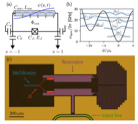
    Disordered superconducting materials provide a new capability to implement novel circuit designs due to their high kinetic inductance.Here, we realize a fluxonium qubit in which a long NbTiN nanowire shunts a single Josephson junction. We explain the measured fluxonium energy spectrum with a nonperturbative theory accounting for the multimode structure of the device in a large frequency range. Making use of multiphoton Raman spectroscopy, we address forbidden fluxonium transitions and observe multilevel Autler-Townes splitting. Finally, we measure lifetimes of several excited states ranging from \(T_1=620\) ns to \(T_1=20~\mu\)s, by applying consecutive \(\pi\)-pulses between multiple fluxonium levels. Our measurements demonstrate that NbTiN is a suitable material for novel superconducting qubit designs.

  • Figure from Transport Measurements of Surface Electrons in Helium-Filled Microchannels

    Transport Measurements of Surface Electrons in 200 nm Deep Helium-Filled Microchannels Above Amorphous Metallic Electrodes

    A. T. Asfaw, E. I. Kleinbaum and S. A. Lyon

    Journal of Low Temp. Phys. 195, 300–306 (2019).

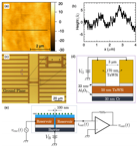
    We report transport measurements of electrons on helium in a microchannel device where the channels are 200 nm deep and \(3~\mu\)m wide. The channels are fabricated above amorphous metallic Ta\(_{40}\)W\(_{40}\)Si\(_{20}\), which has surface roughness below 1 nm and minimal variations in work function across the surface due to the absence of polycrystalline grains. We are able to set the electron density in the channels using a ground plane. We estimate a mobility of 300 cm\(^2\)/V\(\cdot\)s and electron densities as high as 2.56\(\times10^{9}\text{ cm}^{-2}\). We demonstrate control of the transport using a barrier which enables pinchoff at a central microchannel connecting two reservoirs. The conductance through the central microchannel is measured to be 10 nS for an electron density of 1.58\(\times10^{9}\text{ cm}^{-2}\). Our work extends transport measurements of surface electrons to thin helium films in microchannel devices above metallic substrates.

  • Figure from SKIFFS: Superconducting Kinetic Inductance Field-Frequency Sensors

    SKIFFS: Superconducting Kinetic Inductance Field-Frequency Sensors for Sensitive Magnetometry in Moderate Background Magnetic Fields

    A. T. Asfaw, E. I. Kleinbaum, T. M. Hazard, A. Gyenis, A. A. Houck and S. A. Lyon

    Appl. Phys. Lett. 113, 172601 (2018).

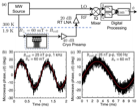
    We describe sensitive magnetometry using lumped-element resonators fabricated from a superconducting thin film of NbTiN. Taking advantage of the large kinetic inductance of the superconductor, we demonstrate a continuous resonance frequency shift of 27 MHz for a change in magnetic field of \(1.8~\mu\)T within a perpendicular background field of 60 mT. By using phase-sensitive readout of microwaves transmitted through the sensors, we measure phase shifts in real time with a sensitivity of 1 degree/nT. We present measurements of the noise spectral density of the sensors, and find their field sensitivity is at least within one to two orders of magnitude of superconducting quantum interference devices operating with zero background field. Our superconducting kinetic inductance field-frequency sensors enable real-time magnetometry in the presence of moderate perpendicular background fields up to at least 0.2 T. Applications for our sensors include the stabilization of magnetic fields in long coherence electron spin resonance measurements and quantum computation.

  • Figure from Multi-frequency spin manipulation using tunable superconducting microresonators

    Multi-frequency spin manipulation using rapidly tunable superconducting coplanar waveguide microresonators

    A. T. Asfaw, A. J. Sigillito, A. M. Tyryshkin, T. Schenkel and S. A. Lyon

    Appl. Phys. Lett. 111, 032601 (2017). Selected as Editor's Pick

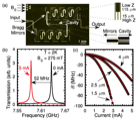
    In this work, we demonstrate the use of frequency-tunable superconducting NbTiN coplanar waveguide microresonators for multi-frequency pulsed electron spin resonance (ESR) experiments. By applying a bias current to the center pin, the resonance frequency (\(\sim\)7.6 GHz) can be continuously tuned by as much as 95 MHz in 270 ns without a change in the quality factor of 3000 at 2K. We demonstrate the ESR performance of our resonators by measuring donor spin ensembles in silicon and show that adiabatic pulses can be used to overcome magnetic field inhomogeneities and microwave power limitations due to the applied bias current. We take advantage of the rapid tunability of these resonators to manipulate both phosphorus and arsenic spins in a single pulse sequence, demonstrating pulsed double electron-electron resonance (DEER). Our NbTiN resonator design is useful for multi-frequency pulsed ESR and should also have applications in experiments where spin ensembles are used as quantum memories.


Science Communication

I've always been excited about sharing the joy and complexity of quantum computing with students. Part of it is because I learn something new (a tool, a quantum information concept, a new experimental technique) every time I prepare a talk, and part of it is because I enjoy the process of enablement -- seeing someone connecting the dots and starting to come up with ideas.
  • Thumbnail from Qiskit Global Summer School 2020 lecture

    Qiskit Global Summer School 2020

    In 2020, as remote learning was taking off, my team organized the world's largest quantum computing summer school at the time, with 4000+ learners from 100+ countries. I gave the lectures showing how to implement Shor's algorithm using quantum circuits from scratch, along with the associated mathematics. In this two-week virtual program, we taught participants with little to no prior experience how to write quantum algorithms, understand superconducting device physics, and solve quantum chemistry problems using Qiskit.

  • Thumbnail from Coding with Qiskit video series

    Coding with Qiskit

    A 9-episode video series explaining how to program quantum computers using Qiskit, with emphasis on hands-on experimentation. Starting with installing Qiskit, through programming a quantum Hello World application, to investigating the latest algorithms and research topics, the series is designed for any student with internet access to learn quantum computing hands-on.

  • Screenshot from Introducing the open-source Qiskit textbook blog post

    Introducing the open-source Qiskit textbook

    In 2019, open-source quantum programming software existed, along with access to quantum computers through the cloud. But quantum computing courses hadn't updated to take full advantage of these resources. The Qiskit textbook was a first attempt at integrating hands-on experimentation using these open-source tools into the pedagogy of the most popular textbooks in the field used in a first quantum course. This blog outlines the vision and start of this journey. By 2022, 100+ courses worldwide were using these materials.

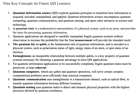
  • Screenshot from Key Concepts for Future Quantum Information Science Learners

    Key Concepts for Future Quantum Information Science Learners

    On behalf of the Interagency Working Group on Workforce, Industry and Infrastructure, under the NSTC Subcommittee on Quantum Information Science (QIS), the National Science Foundation invited 25 researchers and educators to come together to deliberate on defining a core set of key concepts for future QIS learners that could provide a starting point for further curricular and educator development activities. The deliberative group included university and industry researchers, secondary school and college educators, and representatives from educational and professional organizations. The workshop participants focused on identifying concepts that could, with additional supporting resources, help prepare secondary school students to engage with QIS and provide possible pathways for broader public engagement. This workshop report identifies a set of nine Key Concepts. Each Concept is introduced with a concise overall statement, followed by a few important fundamentals. Connections to current and future technologies are included, providing relevance and context.

  • Thumbnail from TechTalk with Solomon interview on EBS TV

    TechTalk with Solomon (EBS TV)

    Interview on the most popular technology TV show in Ethiopia, where I gave a brief introduction to quantum computation and qubits, shared my excitement about the field, and invited more Ethiopians to join the field.

  • Thumbnail from Quantum Programming with Cirq video series

    Quantum Programming with Cirq

    A video series introducing Cirq, Google's open-source Python framework for quantum circuits. The series covers how to get started with Cirq, build quantum circuits, and run them on quantum simulators.


Research Talks

For a list of presentations that I gave as part of my Ph.D. and earlier, click this button to expand below.
  • A Asfaw, E Kleinbaum and S.A. Lyon, Transport measurements of electrons above shallow helium-filled microchannels, March 2019, Contributed Talk, APS March Meeting (Boston, Massachusetts)
  • A Asfaw, A.J. Sigillito, A.M. Tyryshkin, T. Schenkel and S.A. Lyon, Multi-Frequency Pulsed EPR and DEER Using Rapidly Tunable Superconducting Microresonators, July 2018, EPR Oral Session Talk, 59th Rocky Mountain Conference on Magnetic Resonance (Snowbird, Utah)
  • A Asfaw and S.A. Lyon, Superconducting Kinetic Inductance Field-Frequency Sensors: High-Sensitivity Magnetic Field Sensing in Moderate Background Fields, March 2018, Contributed Talk, APS March Meeting (Los Angeles, California)
  • A Asfaw and S.A. Lyon, Superconducting Kinetic Inductance Field-Frequency Sensors: High-Sensitivity Magnetometry in Moderate Background Fields, February 2018, Poster, Princeton Center for Complex Materials Annual Poster Night (Princeton, New Jersey)
  • A Asfaw and S.A. Lyon, Superconducting Kinetic Inductance Devices for Electron Spin Resonance Applications, December 2017, Talk, Quantum Group Meeting (Princeton, New Jersey)
  • A Asfaw, AJ Sigillito, AM Tyryshkin, and SA Lyon, Current-Tunable NbTiN Coplanar Photonic Bandgap Resonators, March 2017, Contributed Talk, APS March Meeting (New Orleans, Louisiana)
  • A.T. Asfaw, A.M. Tyryshkin, and S.A. Lyon, Tracking Magnetic Field Fluctuations in Electron Spin Resonance, August 2016, Poster, Gordon Research Conference: Defects in Semiconductors, (New London, NH)
  • A.T. Asfaw, A.M. Tyryshkin, and S.A. Lyon, Tracking Magnetic Field Fluctuations in Electron Spin Resonance, August 2016, Poster, Gordon Research Seminar: Defects in Semiconductors, (New London, NH)
  • A.T. Asfaw, A.M. Tyryshkin, and S.A. Lyon, Tracking Field Fluctuations in Pulsed EPR, July 2016, EPR Oral Session Talk, 58th Rocky Mountain Conference on Magnetic Resonance, (Breckenridge, CO)
  • A Asfaw, A Tyryshkin, and S Lyon, Dynamic field-frequency lock for tracking magnetic field fluctuations in electron spin resonance experiments, March 2016, Contributed Talk, APS March Meeting (Baltimore, Maryland)
  • A. Asfaw, Introduction to Quantum Computation and Quantum Algorithms, 2-day workshop presented at 4-kilo campus, Addis Ababa University (2015).
  • A Asfaw, G Wolfowicz, JJL Morton, A Tyryshkin, and S Lyon, Spin Ensembles as Sensitive Probes of Environmental Magnetic Field Noise, March 2015, Contributed Talk, APS March Meeting (San Antonio, Texas)
  • A.T. Asfaw, A.M. Tyryshkin, and S.A. Lyon, Suppressing Effects of Magnetic Field Noise in Long Echo Decay Measurements, July 2014, EPR Oral Session Talk, 56th Rocky Mountain Conference on Magnetic Resonance, (Copper Mountain, CO)
  • A. Asfaw and P. Boothe, Computing Backwards, 7th Annual Spuyten Duyvil Undergraduate Mathematics Conference (NSF Grant DMS-0846477) (2012)
  • A. Asfaw, Computability and Turing Machines, Department of Mathematics and Computer Science, Manhattan College (2011)
  • A. Asfaw, Mersenne Primes and the Global Internet Mersenne Prime Search (GIMPS), 6th Annual Spuyten Duyvil Undergraduate Mathematics Conference (NSF Grant DMS-0846477) (2011)
  • A. Asfaw, Moments of Velocity in Arbitrary Dimension, 5th Annual Spuyten Duyvil Undergraduate Mathematics Conference (NSF Grant DMS-0846477) (2010)